Three Clues to Look for on a Leaf
Compare a leaf’s margin, veins and arrangement to describe its form more clearly and avoid mistaking one familiar outline for a reliable plant name.
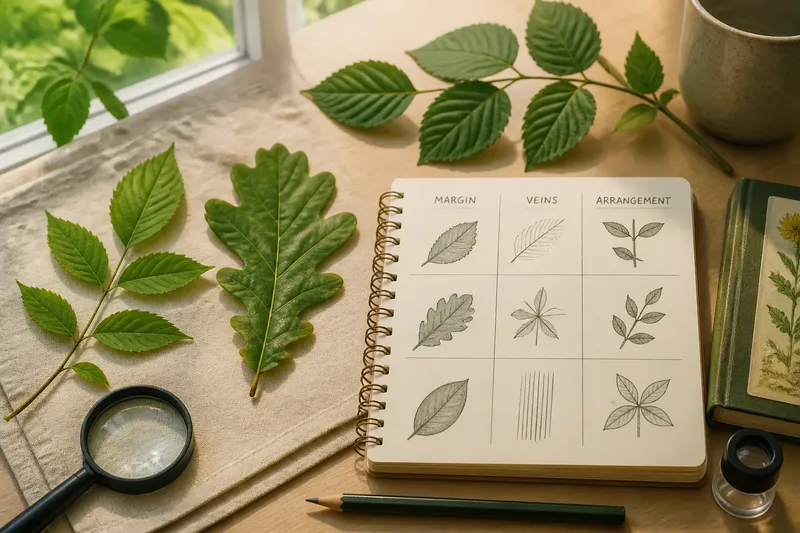
The common mistake in leaf identification is to judge a plant by its outline alone. A toothed edge may catch your eye, but relying on it costs you two other useful clues: the vein pattern and the way leaves grow on the stem. Looking at all three gives you a fuller description without forcing a name.
Three leaf clues
The line around a leaf is its margin. It may be smooth, toothed, lobed or cut into deeper divisions. Veins form patterns across the blade, while arrangement describes how leaves sit along a stem or twig. These are separate observations, not different kinds of edge.
Keep them separate in your notes. A simple description such as “toothed margin, feathered veins, opposite leaves” is more useful than calling a plant “jagged” or writing down a guess before you have looked closely.
Read the margin
A smooth margin has no obvious teeth or lobes. A toothed margin has small projections, which may point towards the tip or form rounded scallops. Lobes are broader sections divided by inlets; an oak leaf has a lobed outline, while a nettle leaf is toothed. Calling both “jagged” loses that distinction.
Look at the whole blade, from its base to its tip. Notice whether the teeth are fine or coarse, regular or uneven, and whether the inlets between lobes are shallow or deep. A hand lens can help, though a steady look in daylight is often enough.
Follow the veins
The midrib is the main vein running through many leaves, often from the base towards the tip. Smaller veins branch from it in a feather-like pattern. In other leaves, several strong veins spread from near the base, like fingers from a palm. Long, narrow leaves may have veins that run alongside one another.
Turn an attached leaf gently towards the light, or hold a fallen leaf against a bright window. This can make fine lines easier to see. Do not assume that a particular margin always comes with a particular vein pattern: similar-looking edges can sit over quite different networks.
Check leaf arrangement
Leaves may grow one at a time, alternating from one side of a stem to the other, in opposite pairs, or in a circle around the stem. Follow the stem with your eyes rather than judging a single leaf; overlap and wind can hide the pattern.
Also check whether an apparent single leaf is made of leaflets. A compound leaf has several leaflets attached to a shared stalk, while a simple leaf has one blade at its attachment to the stem, even if its margin is deeply cut.
A fallen leaf cannot show where it grew on the stem. Mark arrangement as unknown instead of filling in the gap with a guess.
Make a useful comparison
Say you find two green leaves on a garden path, both pointed and toothed. You note that the first has side veins branching from a midrib, while the second has several strong veins spreading from near its base. Nearby, you can see that one living plant carries its leaves in opposite pairs. The resulting notes distinguish visible features, but they do not establish a certain name for either plant.
A notebook or phone note can hold three observations for each plant: margin, veins and arrangement. Add the blade’s general shape and the setting when they are clear. Keep uncertain details marked as unknown, and check buds, flowers or fruit before relying on a tentative identification.
- Observe a smooth margin; if no teeth or lobes are visible, record “smooth”, otherwise describe the projections rather than using that label.
- Observe small pointed projections; if they form teeth, note their direction and size, otherwise check whether the edge has rounded scallops or broad lobes.
- Observe broad sections separated by inlets; if the divisions are lobes, record their depth, otherwise describe the outline as toothed or smooth.
- Observe a central midrib with side branches; if the veins form a feather-like pattern, record that, otherwise look for veins spreading from the base or running alongside one another.
- Observe leaves alternating along a visible stem; if each attaches singly, record “alternate”, otherwise check for opposite pairs or a circle around the stem.
- Observe several small blades on one shared stalk; if they meet the stem at one attachment as a group, record a compound leaf, otherwise check whether each blade attaches separately.
What can leaf clues tell?
Can one margin identify a plant?
No. Unrelated plants can share smooth, toothed or lobed margins, and leaves on the same plant can vary. Use the margin alongside veins, arrangement and other visible features.
How can I see veins clearly?
Turn an attached leaf towards daylight or hold a fallen leaf against a bright window. A hand lens can reveal fine branching, but there is no need to tear a living leaf for a closer view.
How do I tell a leaflet from a leaf?
Follow the stalk back towards the stem. A compound leaf has several leaflets on a shared stalk attached at one point; a simple leaf has one blade at its attachment.
What if arrangement is hidden?
Record only what you can see. A loose or fallen leaf may show its margin and veins clearly, while its original position on the stem remains unknown.
Leave some effort aside
It is not worth trying to name every plant from a cropped photograph of one outline, or collecting specimens when a careful look will do. A photograph that hides the stem cannot show arrangement, and damage or shade can make a margin harder to read. A plain description is still a useful result.
For a clear leaf comparison, start with the margin, follow the veins, then look at the arrangement on the living plant. Recording what is visible—and leaving uncertain details blank—keeps your description useful without asking any single clue to identify the whole plant.