A Window-Sill Watch for a Rainy Hour
A window-sill watch for a rainy hour reveals how drops travel and how shifting daylight changes the patterns you can see, without special equipment.
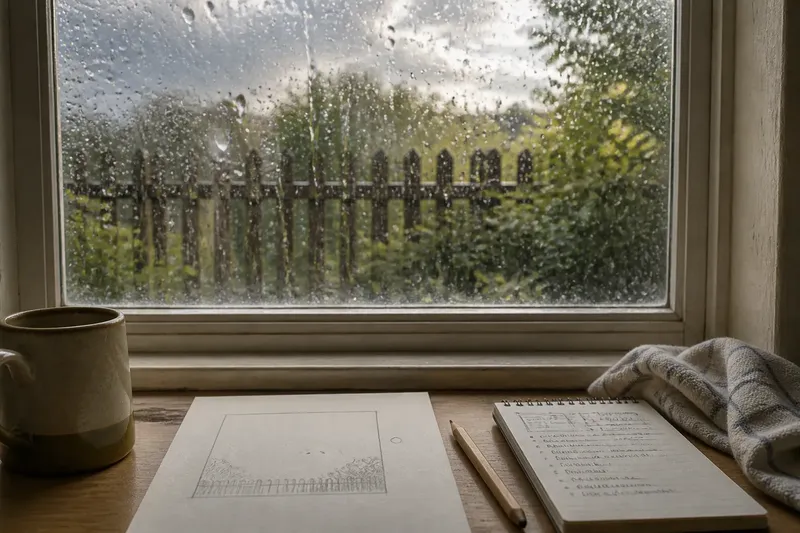
The common mistake during a rainy hour is to glance at the window once, decide the rain is simply running down, and turn away. That misses the small changes that make a window-sill watch interesting: drops pause, join, split, and vanish from view as the light shifts. A pencil, a sheet of paper and a place to sit are enough to follow the action without touching the glass.
Settle beside the pane
Choose a window you can watch comfortably from indoors. A clear pane makes droplet paths easiest to follow, but a slightly marked window can add texture; just choose one area and stay with it. Keep the sill free of objects that block your view, and sit back far enough to see the whole patch at once.
Say you are watching rain from a kitchen chair on a grey afternoon. You choose a pane with a narrow view of a garden fence, then use the fence as a steady background. On a scrap of paper, draw a simple rectangle for the glass. Add a small mark beside the area you plan to observe, so you can return to the same patch after looking away.
Before you begin, note what the light is doing: flat and grey, bright through a cloud gap, or dimming towards evening. There is no need to judge the weather beyond the window. The point is to keep a simple record of how the scene looks now, so a later change has something to be compared with.
Follow a drop’s route
Pick one drop that is easy to distinguish from its neighbours. It might be a rounded bead, a thin trail, or a larger drop that has gathered other water. Watch without trying to predict where it will go. A drop may creep downwards, hold still, merge with another, or break into a smaller shape.
Use a short mark or arrow on your paper to record its position and direction. If you look away to make a note, find it again by matching its location to the fence or another fixed feature outside. Avoid marking the glass itself; a drawn map is easier to change and keeps the view clear.
In the imagined kitchen scene, the chosen bead slides a little, stops, then joins a narrow track below it. The larger shape continues down the pane while a faint wet line remains above. The observer records the pause and the joining rather than treating the drop as one smooth journey. That detail is the useful result: a route can have several small events, not just a start and finish.
If the path becomes hard to follow, choose a fresh drop and note why. Perhaps it disappeared into a wider trail, passed behind a reflection, or ran out of the marked patch. Losing sight of a drop is not a failure; it is a reminder that the window offers a view, not a complete record of every movement.
Read the changing light
After following a drop, look again at the whole marked area. Rain can appear sharply defined against a dark hedge, then turn nearly invisible when a bright patch of sky reflects in the pane. A lamp inside the room may create another reflection. Those changes can make the same trail look wider, brighter or less distinct without the water itself changing in the same way.
Record the light in plain words rather than trying to classify it precisely. “Fence clear, glass dark” or “bright reflection over left side” is enough. If the outside view grows brighter, notice whether you can still see the same drops. If the room becomes darker, look for reflections that may now stand out more strongly.
In the invented watch, a cloud gap brightens the garden. The fence becomes easier to see, but some fine trails fade against the lighter background. A little later, the light softens again and the trails return to view. The observer’s notes show that visibility changed with the scene; they do not prove that the rain grew heavier or lighter.
Keep a small record
A useful record needs only a few observations. Write the time in ordinary terms, such as “early afternoon” or “after the light brightened”, rather than fussing over exact timing. Add the drop’s location, what it did, and what the background looked like. A quick sketch is often clearer than a paragraph of description.
- Starting view: note the patch of pane and a fixed feature outside.
- Drop shape: describe it as a bead, narrow line, joined trail or scattered specks.
- Movement: record a slide, pause, merge, split or disappearance.
- Light: describe whether the view is flat, brightened, dimmed or crossed by reflection.
- Uncertainty: mark when you lose the drop or cannot tell whether the appearance changed.
For the imagined observer, these notes make a modest sequence: a bead pauses, joins a trail, then becomes difficult to distinguish when the garden brightens. The written record does not need to tell a bigger story than the window supports. Its value is that it preserves what was visible at each glance.
What changes the view?
Why do raindrops pause on glass?
A drop can appear still when its movement is very slight or when it is held by the surface and nearby water. You may also mistake a reflection or a mark on the glass for a stationary drop, so compare its position with a fixed feature outside.
Why does a drop join another?
When two wet paths meet, their water can gather into one larger shape and continue along the pane. From your seat, the joining may happen between glances, so note the change you can see rather than guessing at the exact moment.
Why do trails disappear in bright light?
A trail may become harder to distinguish when its background brightens or a reflection crosses it. The water may still be there; compare the same patch after the light changes again before deciding that the trail has gone.
Should I touch the window?
No touch is needed for this observation, and pressing or tracing on the pane can interrupt the view. If you cannot follow a drop clearly, choose another one or describe the uncertainty in your notes.
Let the watch end naturally
Stop when the rain eases, the light fades, or you simply lose interest. Return to your sketch and circle one change you can describe plainly, such as a drop merging with a trail or a reflection masking the lower part of the pane. Leave interpretations about the wider weather aside; one window cannot establish what is happening beyond its view.
In the hypothetical kitchen scene, the observer finishes with a short record of a bead’s stop, its joining with a wet line, and the later shift in visibility. The result is not a forecast, but a clearer account of what happened in that small patch of glass. A window-sill watch for a rainy hour works best when the notes distinguish movement from appearance: that simple habit makes the next rainy glance more rewarding, even if it lasts only a moment.
What is not worth the effort is trying to follow every drop or to make the sketch look accurate. Choose one route, keep the wording honest, and let the pane supply the details.