The First Warm Day Is Not the Whole Season
The first warm day can tempt you to call spring early. Learn which small, repeated signs make a seasonal shift more convincing than one sunny afternoon.
The common mistake on the first warm day is to treat it as proof that spring has arrived. That can mean putting away a coat too soon or moving a tender pot into a spot where a chilly night catches it out. A mild afternoon is lovely; the more useful question is what the changing season is doing to the light, the ground and the plants around you.
Follow the changing light
Instead of asking whether a single day feels springlike, notice how the light falls in a familiar place. A low winter sun can make one bright patch on a wall, while the path beside it stays cold. As the weeks pass, the sun’s position changes; the bright patch may appear elsewhere or last longer.
This is a different clue from warmth. You can notice it without a thermometer: look at the same window, garden wall or tree shadow during an ordinary walk. The changing angle of light gives the season a quiet signature, even when the weather keeps switching between mild and cold.
Notice the local calendar
Plants do not all respond at once. A blackthorn hedge may flower while nearby trees remain bare; snowdrops can fade as daffodils open. The order will vary with place and conditions, so a familiar patch is more informative than a general expectation of what “should” be happening.
Choose a small natural landmark: a tree by a bus stop, a patch of bulbs beside a footpath or a hedge at the end of your street. Notice what changes there, and which signs arrive together. You are not trying to name a definitive start date; you are learning the character of that particular corner through the season.
Read the ground’s response
Air can feel warm while the ground remains cold or sodden. Look for practical signs of the ground’s condition: whether puddles linger, whether paths are still slick with mud, or whether new shoots are pushing through a sheltered verge. These details connect seasonal change to the places where plants grow and people walk.
Keep to paths when ground is soft, particularly in parks and woodland. Repeated trampling can damage muddy edges and young growth, so observation from a path is often kinder as well as easier.
Make a small seasonal map
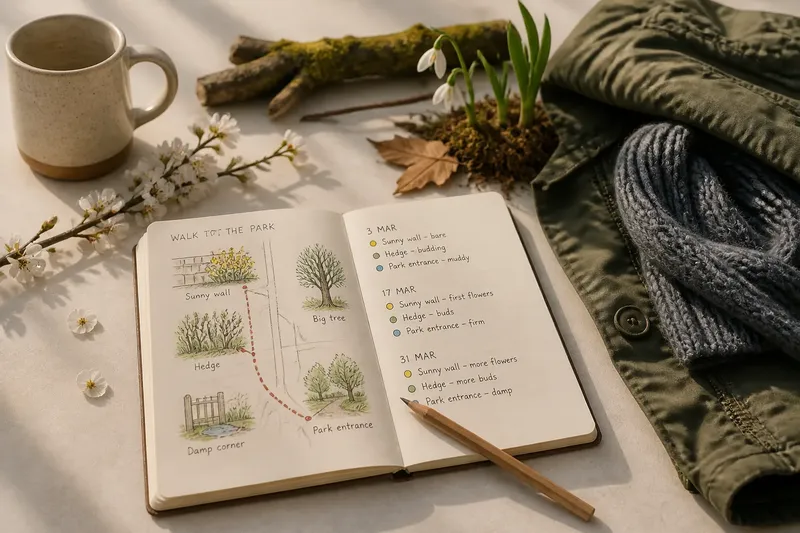
A seasonal note need not be a diary. On a scrap of paper, sketch a simple route or mark a few landmarks: the sunny wall, the shady hedge, the damp corner by the gate. Add a short word beside each place—“bare”, “buds”, “flowers” or “wet”—when you pass. The map helps you see how different parts of one neighbourhood move at different paces.
Say you choose a route from your front gate to a nearby park. At the start, you mark the sunny wall as bare, the hedge as budding and the park entrance as muddy. On a later walk, the wall has its first flowers, the hedge still has buds, and the entrance is firm after dry weather. Your map records a mixed transition: the flowers are a local sign of change, while the ground and hedge tell a slower story. It is more useful than declaring the whole route to be spring.
When do the signs disagree?
Why can one street feel springlike and another still wintry?
Walls, trees and buildings create sheltered or shaded pockets, while open places meet more wind and weather. A warm, protected corner can change before an exposed stretch nearby.
Should I expect the same flowers each year?
Not necessarily. Weather and local conditions affect when plants appear, and different species follow their own seasonal rhythms. Notice what is present rather than treating one familiar date as a rule.
Is a patch of blossom proof that winter is over?
No. Blossom is a sign of what that plant is doing, not a promise about the next spell of weather. Enjoy it, but keep a coat handy if the forecast calls for colder conditions.
Do I need a notebook to notice seasonal change?
No. A repeated glance at the same tree or view can be enough. If you want to remember details, a note or a photograph from the same spot makes comparisons easier.
Keep garden decisions local
A bright afternoon can make garden work tempting, but the sun on your face does not tell you whether a bed is workable or a plant is ready for a change. Check the soil where you plan to work and consider the needs of the particular plant. For a valuable or vulnerable plant, follow its care label or ask a local horticultural professional.
Not worth the effort: marking one exact day as the season’s official turning point. Local signs rarely line up so neatly, and a label cannot tell you what a shaded corner or exposed border needs.
The first warm day is a pleasant invitation to look around, not a verdict on the season. If you search for signs of seasonal change, begin with one small place you pass often: the shifting light, a flowering hedge or the state of the path can tell you more about its own corner than a sweeping seasonal label ever could.